Beyond ultralight: What backpacking weight is really about
Updated: Aug 13
How much should you really carry into the backcountry? Backpacker Jordan Irion breaks down the balance between ultralight ambitions and being prepared for whatever the trail brings. From essential gear to comfort items, discover why the smartest pack is not always the lightest one.
BY Kay Esposito., August 3, 2026
BACKPACKING ESSENTIALS
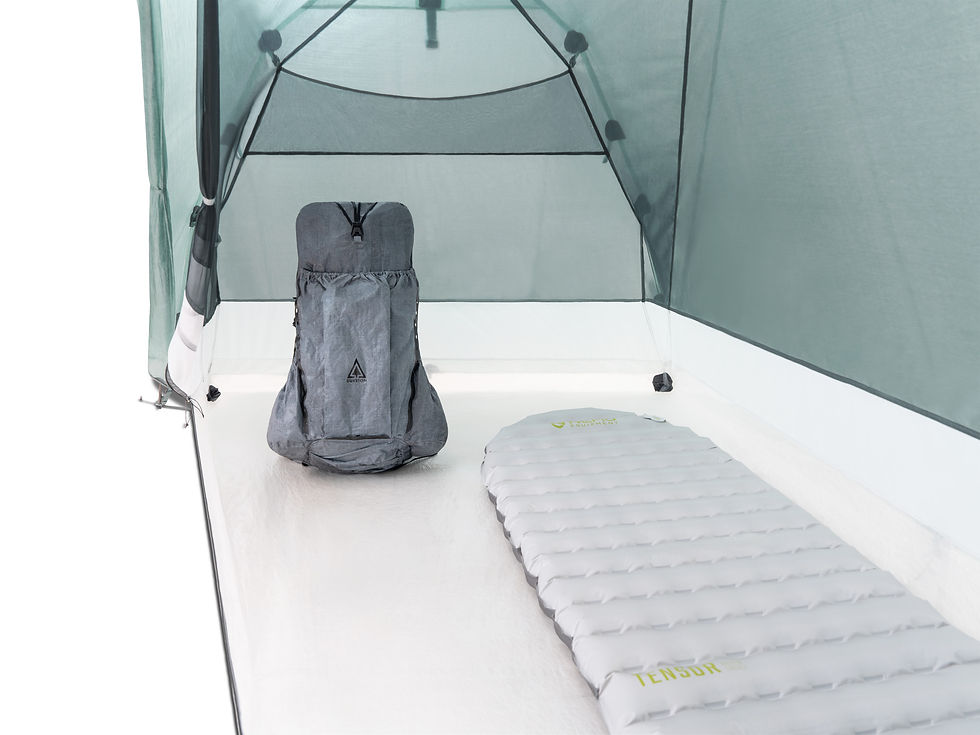
Photo credit I Owen Watters
The conversation surrounding backpacking weight often centers on an age-old question: should hikers carry less or prepare for every possibility? For backpacker Jordan Irion, that debate falls into the comfort-luxury spectrum.
Every item placed inside a backpack represents a decision about efficiency, safety and necessity and making thoughtful preparation is more important than achieving your “lightest” weight.
“I do not ‘pick a side,’” he says, “but I do think those who thoughtfully choose everything they bring, ultralight or not, are the happiest, and won’t be found arguing with strangers in an Instagram comment section.”
Jordan approaches backpacking weight as an exercise in planning according to variations in each outing, rather than as standardizing preference. He does not identify with either the ultralight or traditional backpacking communities because, in his view, both approaches can be appropriate depending on the objective of the trip.
In general, Jordan approaches his own packing philosophy with a minimalist mindset. He sees outdoor adventures as anything between normal city life and survival. And packing should adjust accordingly.That perspective arrives as lightweight backpacking equipment has become increasingly visible.
Social media platforms, gear reviews and online hiking communities often espouse lighter packs. Manufacturers continue producing compact tents, sleeping systems and backpacks. While these developments have made backpacking more accessible, they have also encouraged a perception that reducing pack weight is an objective in itself.
For Jordan, this is a mistake. He compares the phrase "let's go on a hike" to suggesting "let's go get food," arguing that each could describe countless experiences requiring entirely different levels of preparation.
In essence, lighter is something to shoot for, but it's fully dependent on the trip itself
In balancing preparedness with comfort, Jordan suggests leaning into comfort and over preparedness. For him, beyond the minimum of six gear items backpacking requires, everything else could be considered comfort.
During shorter recreational outings, he believes there is little reason to avoid comfort items if the physical demands remain modest. For more demanding adventures, such as for thruhikers and the PCT, even an extra half pound could mean not finishing the trail. The first step, Jordan believes, is always to determine the essential necessities. After that, comfort can be considered.
Another consideration is the environmental factors that determine whether or not reducing weight is advantageous. For Jordan, distance and elevation are the biggest factors, affecting the amount of water, food and gear to bring.
Rather than estimating water needs intuitively, he recommends calculating expected consumption according to hiking time and elevation gain. Clothing follows a similar process.

Breathable synthetic materials perform well during warmer conditions, while colder environments require insulating layers, waterproof shells and sleep systems matched to anticipated overnight temperatures.
Jordan suggests that, “A good rule for water is 0.5 liters every hour of moderate hiking, adding another 0.5 liters per 1,000 ft gained. The weather affects clothing required: always breathable synthetic materials, but layering on top with a fleece in colder temps, and a waterproof jacket for any precipitation. Sun hoodie for direct, consistent sunlight under UV above 4.”
Certain pieces of equipment, however, remain consistent. Jordan always carries a first aid kit, adequate food and water, and a Garmin inReach Mini, which provides satellite communication, weather updates, location tracking and emergency rescue capabilities beyond cellular coverage. He also emphasizes that hydration begins before reaching the trailhead, with water and electrolyte intake continuing throughout the hike as physical exertion increases.
“I always bring my Garmin inReach Mini. It allows me to send messages, track my location, check weather, and summon a rescue helicopter in an emergency,” he says, “Besides that, the only other thing I bring on day hikes is my monocular for animal spotting.”

Although discussions surrounding backpacking often focus on carrying too little, Jordan believes overpacking remains one of the most common mistakes among newer hikers. His own experience reflects that learning process. Early backpacking trips were accompanied by a packing list that ultimately proved unnecessary: Cooking supplies, books, journals, additional clothing and other items.
Gradually experience taught him that overpacking is often a result of fear and lack of experience. As his understanding of backpacking evolved, he reduced both the volume of his backpack and the weight it carried, eventually transitioning to a 44-liter pack weighing between 25 and 30 pounds depending on the season and objective.
“People want to be prepared for anything, but in reality,” he says, “wherever you plan to visit doesn’t have “everything,” but instead a specific and knowable set of obstacles and environments you can plan for.”

Jordan does not believe beginners should approach packing differently from experienced hikers. He suggests that the difference lies in access to information rather than years spent on the trail. Understanding how elevation, weather, water availability and seasonal conditions influence equipment choices allows new hikers to make informed decisions even before hitting the trail.
Seasonal conditions provide another example of why backpacking cannot be reduced to a universal weight-based list. Warm-weather trips emphasize breathable synthetic clothing and protection from prolonged sun exposure.
As temperatures decline, additional insulating layers, waterproof shells, appropriately rated sleeping bags and dry clothing are needed. Jordan calls this his “modular set of layers” philosophy, where your pack should be relatively consistent besides interchangeable layers customized for each trip.
It is clear that the growing popularity of ultralight backpacking has influenced how hikers think about equipment. Advances in materials have reduced the weight of backpacks, tents, clothing and sleep systems while making specialized gear more widely available.
Jordan views those developments as mostly positive because they have encouraged hikers to think more deliberately about what they carry. On the other hand, he also cautions against treating pack weight as a competition, either with oneself or others.

The takeaway? The debate over ultralight backpacking might be less significant than it often appears. A backpack weighing 20 pounds is not inherently better than one weighing 35, just as a heavier pack does not necessarily indicate better preparedness.
As Jordan has suggested, it is grounding packing decisions in terrain, weather, elevation and objective that should define weight. Not the competition of “who can do it best,” lightest, and techiest.
Jordan’s Typical Day Hike Packing List:
● 1–2L of water
● Salty and sweet snack
● A map and a plan
● Sandwich for lunch
● First aid
● Garmin or similar
● Headlamp
● Sun protection
● Pocket knife / multitool
● Rain shell or fleece (weather dependent)
● Trekking poles
You are warmly invited to follow Jordan’s continued journey on Instagram: (@jordanirion)


.png)