Documenting the Forgotten Grasslands of the American West
Updated: Mar 16

Conservationist and Photographer Christopher, recognized online as @landofthelonesome, spends extended days crossing the High Plains with a film camera and a field biologist’s discipline, documenting grassland ecosystems across the American West and High Plains often overlooked in mainstream coverage. The images he creates form part of an ongoing series he calls “Postcards From,” a project that has become central to how he studies and communicates the character of these landscapes.
“My day job has been focused on conservation biology for a few years now and while there hasn’t been much direct overlap between conservation work and my photography, it’s definitely a big driver of the passion I have for the places I photograph," Christopher said.
Christopher approaches fieldwork in a manner that resembles ecological surveying. He spends most of each trip driving between predetermined coordinates that he has marked on satellite imagery before heading out. He maps location orientation to the trajectory of the sun and builds loose itineraries that allow for rapid changes when weather shifts.
The goal is to maintain a steady rate of documentation rather than wait for a particular set of conditions that may never materialize. This workflow keeps him engaged with the landscape throughout the day and reduces the pressure to chase single iconic scenes.
He shoots exclusively on film, which requires a level of discipline that often aligns with the constraints of biological field studies. Film limits volume and forces previsualization before committing to an exposure. Christopher relies on 35 mm and 50 mm prime lenses because they approximate human visual perspective and require him to physically reposition himself to reframe rather than correct errors in post-production.

His process is built on removing variables in order to preserve clarity in the field. He prefers to keep edges clean, avoid unintentional alignments of horizons or structures, and construct images that reflect deliberate decision making.
Sometimes it’s just taking the time to appreciate a beautiful view
"Often it’s slowing down and taking the time to appreciate the natural world that surrounds me," he said. "Just getting down on my knees and admiring the plants and insects that can survive on such a harsh landscape or that meadowlark calling from the top of a yucca…The prairie, at first glance, can feel like an empty void but if you slow down and take the time to appreciate the small things, a world full of beauty is revealed.”
The “Postcards From” series emerged not from a shift in his compositional technique but from a change in mindset. Early in his career he focused on producing stand-alone photographs captured during highly selective windows of the day. The method limited what he felt he could produce and often left him dissatisfied.
He later began working in sequences instead of isolated frames. This change allowed him to highlight the ecological and spatial qualities of each location through accumulative storytelling. A photo that might not function alone could become essential when interpreted alongside others. The approach mirrors ecological monitoring, where single observations gain significance only when viewed as part of a dataset.

Christopher’s professional background in conservation biology is a core influence on this shift. He has spent several years working on avian research and habitat monitoring in Colorado, including monitoring Bald Eagles through the breeding season in the heavily developed urban corridor along the Front Range.
His primary assignment was to document survival and reproductive outcomes at nests exposed to construction, human activity and other pressures. The project demonstrated how adaptable raptors can be in fragmented environments. It also revealed a level of public interest that he continues to consider when thinking about environmental communication. Workers at the construction sites followed the birds closely and shared their own observations with him, creating a model for community engagement that persists in his memory.
Seeing the excitement and enthusiasm for these birds and how they were able to thrive even in the midst of such heavy human activity was an impactful experience for me
His personal connection to these environments began long before his conservation career. Growing up in Florida, he spent summers in the field with his father, who worked in environmental management. As a child he researched ranches for sale across the High Plains and interior West, imagining landscapes he had never visited. These early interests formed a foundation that later shaped his environmental values and informed how he interacts with public lands today. He has since visited and documented many of the places he studied from afar, deepening his understanding of their ecology and cultural history.
“My connection to the land is a direct result of how I was raised by my parents, in particular my dad. He was an avid outdoorsman in Florida and worked in an environmentally focused job when I was younger and I was able to spend many of my summers out in the field with him. Fast forward to now and I’ve had the opportunity to photograph and spend time in every place that I would dream of as a kid…That personal connection to place and my understanding of the ecology has completely shaped my environmental ethos.”
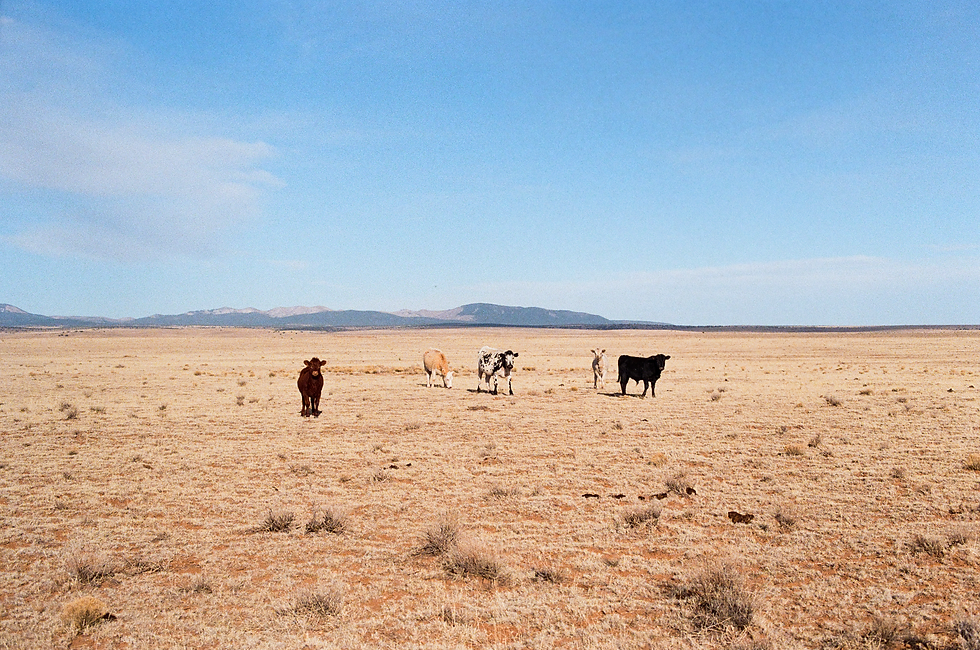
A recurring theme in his work is the need for public awareness of federal lands outside national parks. Christopher stresses that many well-known parks across the West are bordered by national grasslands or Bureau of Land Management territory that often exceeds the park in size and ecological significance. Badlands National Park covers about 244,000 acres, but the surrounding Buffalo Gap National Grassland contains roughly 600,000 acres of similar terrain.
These areas are open to the public without entrance fees and are more vulnerable to policy changes and land transfers. Christopher states that public engagement often focuses on parks because they are more familiar to travelers, while adjacent landscapes remain overlooked despite being ecologically connected:
“While our national parks are at risk, they’re by far the most protected of our public lands and will be the last places to fall so if you love these spaces, do some research into the lands that surround your favorite park. Those are the places that need to be advocated for and are far more likely to slip under the radar.”
Through his photography and conservation background, Christopher aims to provide viewers with an understanding of these systems as functioning landscapes rather than empty spaces. His work documents the interaction between light, landforms, vegetation, and human influence across regions that are often excluded from mainstream outdoor narratives.
The “Postcards From” series continues to expand as he revisits locations, explores new terrain, and applies the same principles of field observation used in ecological research. His images serve as records of place, shaped by methodical planning, scientific training, and a commitment to documenting environments that receive limited attention.
“I adore grassland ecosystems, particularly the short grass prairie of the High Plains and the sagebrush of the American West and I believe that passion and understanding allows me to see beauty in a place so often overlooked. From the plants and animals to the history and weather, I genuinely love all of it and I believe it shows in my work.”
Christopher’s approach reflects the intersection of field science and visual journalism. His work offers a consistent record of changing conditions across vast grassland regions and highlights the need for public awareness of these landscapes. By presenting them with accuracy and restraint, he provides a reference point for understanding their ecological value and their vulnerability in an era of rapid environmental change.
You are invited to follow Christopher’s work on Instagram: @landofthelonesome |
Inquiries regarding the purchase of postcard sets and prints may be sent directly to Christopher through Instagram DMs.


.png)